
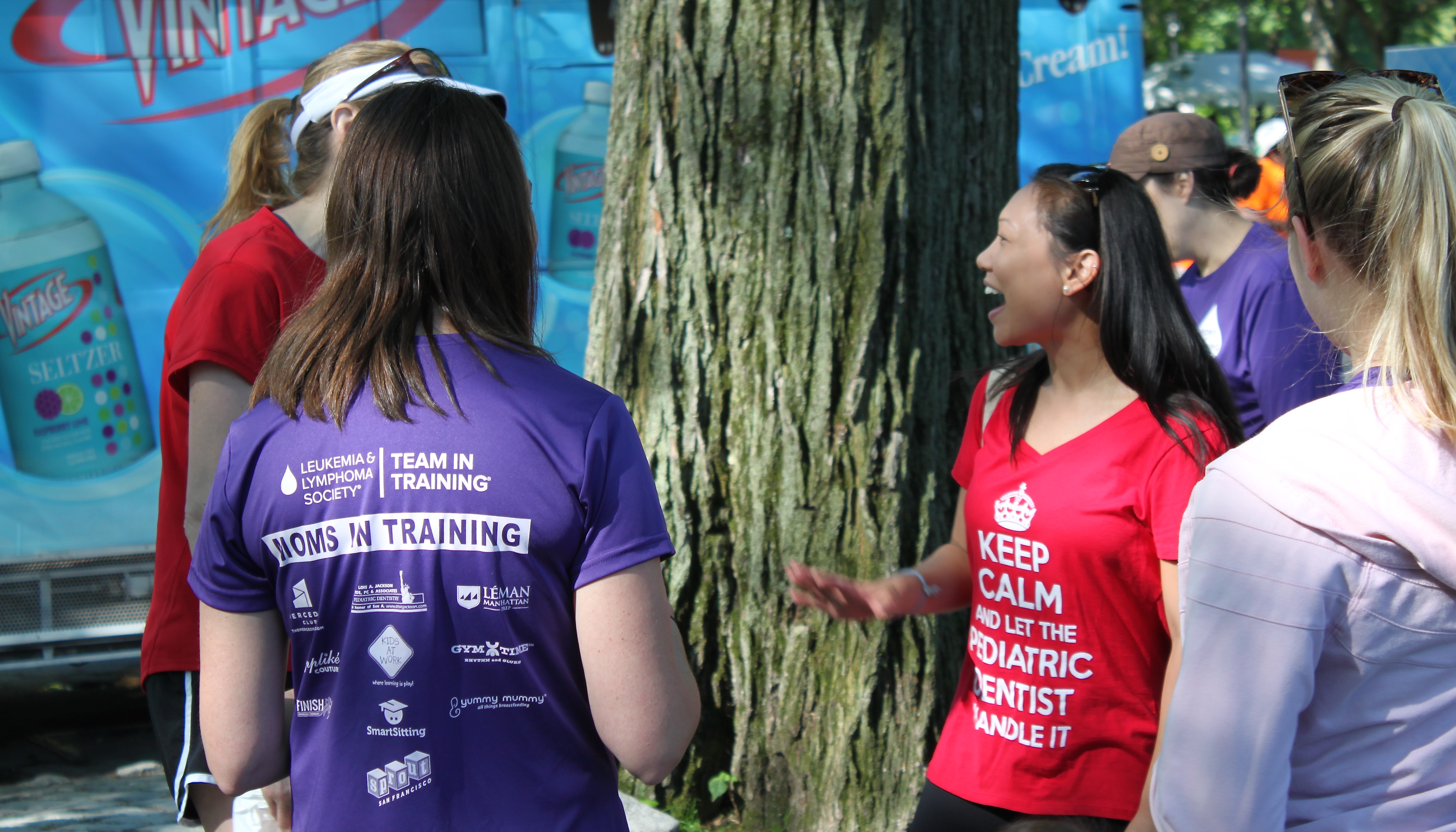
My office, Park View Pediatric Dentistry, is one of the sponsoring partners of Moms In Training -NYC. This past Saturday I had the pleasure of attending their final practice before their next race, The Women’s Fast Track 10K on Saturday, June 14th. Moms In Training is a subdivision of Team In Training, made up of over 300 moms from different New York City neighborhoods. Their mission is to come together for one common goal – to save lives and raise funds for the Leukemia & Lymphoma Society. However, this particular group accomplishes much more. The women in this group motivate each other to get fit, support each other, and have fun. They have professional coaches that help them train and prepare for each race. I was invited on behalf of my office to speak for 2 minutes on why we support this mission. I would have gone running with the moms but as you can see in the photo my left foot is still out of commission following a small foot injury I sustained in the days following my completion of the Brooklyn Half Marathon a few weeks ago. However, once I am allowed to begin to running again, I will most certainly try to get more involved with this group. After all they train in my backyard (Central Park) every week!


Like my shirt?
 I recently came across the amazing story of Lentil, which is heavily trending on the web right now. Lentil is a 6-week-old french bulldog puppy born on February 2, 2013 and is the only survivor in his litter of 4 (one of them also was born with a cleft). Taken from his mother too early, surrendered by his owner, and left in a state when failure to thrive was at its greatest, this little fighter won the hearts of thousands of people all over the web. Now he has almost 23,000 fans (and counting) on his Facebook page, a loving foster Mom and is growing stronger each day – soon to find a forever home with the help of the French Bulldog Rescue Network.
Anyone who knows me knows I’m one of the biggest dog lovers in the world, but this particular story really pulls on my heart strings. During my specialty training in Pediatric Dentistry at Stony Brook University, my director was an integral part of the multi-specialty Cleft Palate-Craniofacial Team at the Stony Brook Medical Center. He would get paged when a baby was born with a cleft (lip, palate, complete or partial) and he would drag us into the hospital to see the whole process begin. I was blown away. Dr. Fred Ferguson would examine the baby, take an impression of the baby’s mouth in sticky compound material and design an appliance that the baby would use to feed (and thus thrive) properly. He would design the appliances with acrylic and medical tape and work off of trial and error, following the babies for weeks and months and continuously designing different appliances designed to help the child feed, mold the soft tissue and other functions in preparation for various surgeries that the child would undergo in phases. It was magically, especially given the fact that Dr. Ferguson was never officially trained to do so. I realized how very crucial that first contact with the baby is in order to set the child on a course to thrive and grow properly. Any child who has the support of a cleft palate team from birth is fortunate as it is not a luxury everyone has access to.Let me return to Lentil who is the first dog I have ever “encountered” that has been affected by a cleft. It’s not just cosmetic, but functional as well. Without the help of his foster mom, a daily 3-hour tube-feeding regimen to keep him healthy, monetary support from donations and the French Bulldog Rescue Network Lentil would not have survived. It’s his own little cleft palate team. As much as I wish I could bring you home myself, I’m rooting for you, special little bean!… I’m sure you will find a wonderful family and home soon!
Follow Lentil’s Blog!


Accidents involving the te eth and face are common among children. A child’s tendency to be active before she can fully develop her motor skills and coordination make accidents unavoidable at times. Thus, the most common age for injuries to occur to baby teeth usually falls between 2-3 years. When your child is older, sporting accidents and car accidents are common causes for damage to her permanent teeth. While dental trauma is common, it is also both highly preventable and highly treatable. Different outcomes from a blow to the face can result in teeth becoming displaced, broken or even knocked out completely. If accidents do happen, take comfort in knowing that most dental injuries are treatable and even a tooth that has been knocked out can be saved if the proper treatment is initiated very soon after the injury occurs. There are certain steps that you should take to improve the long-term survival of a tooth after it has been traumatized.
DO
Do seek advanced medical care for severe injuries
The first thing you should do if your child has had a blow to the head or face is to do a quick assessment of your child’s vital signs. You want to make sure that she has not suffered a concussion. If your child loses consciousness or has any signs of nausea or vomiting following an accident, bring her to the doctor or emergency room as these are signs that she may have a concussion. You should also seek care from a doctor for any other more severe injuries to the face or head. Your child’s medical health is paramount and takes priority over any dental injury. After addressing her health status, your medical doctor can also evaluate her dental injuries and make the appropriate referral to a dental professional.
Do seek guidance from your dentist
If your child has had a dental accident, immediately call a dentist. Because the best outcome for teeth that have been injured involve timely management and treatment, all dentists have an ethical obligation to make sure that reasonable arrangements for emergency dental care are made available to their patients. This may involve assessing your child in person following an injury or triaging and giving an appropriate referral to a doctor or facility that is available for assessment and care. Either way, your dentist will be able to guide you down the right path.
While all dentists have been trained in the management of dental emergencies, pediatric dentists have had advanced training in traumatic injuries specifically in children. When coming in for an assessment, be prepared that even though your child is uncomfortable due to the accident, a thorough clinical exam will be necessary and may include intraoral or extraoral radiographs and tests of the teeth in order to appropriately diagnose what type of injury has occurred and what steps need to be followed.
Do be familiar with the initial first-aid management of teeth following trauma
No matter what the injury, timely actions will be important in order to help save the tooth. Different steps are indicated, depending on the scenario. The International Association of Dental Traumatology (IADT) has a great website designed to guide patients and doctors in the management of acute dental trauma. Here are some general steps you can do to help your child before you see the dentist.
If the tooth is loosened or displaced
- If your child displaces a baby tooth, the concern will most likely be its effect on the adult tooth developing nearby. It is advised not to manipulate the baby tooth and see your dentist for treatment. The dentist may decide to leave the tooth in place or choose to extract it. For an adult tooth, use clean hands and try to reposition the tooth using finger pressure. The earlier you do this after the accident, the easier it will be to reposition because after some time a blot clot will form and make it difficult. In some cases, a tooth may be displaced to the point that it gets locked into a different position in the bone. If you are afraid to hurt your child by snapping the tooth back into place, the dentist can do it. Either way, a trip to the dentist or emergency room will ensure that the tooth will be treated properly. Your child may need to have her teeth temporarily splinted depending on the severity of the injury. The splint is generally a flexible splint that looks similar to braces and will help secure the tooth in place until the bone and gums heal around the affected tooth.
If the tooth is broken
- A blow to the tooth can commonly cause it to chip or fracture. The important thing is to try to locate any broken fragments of the teeth if possible and then go to the dentist or emergency room. Depending on how much the tooth is broken, your dentist will be able to determine what needs to be done. In general, a small chip can be either repaired or smoothed down and left alone. In cases where the fractured piece is large enough to expose the nerve, the dentist will need to do immediate nerve treatment to protect the nerve and avoid infection. The tooth will likely need a full root canal, or endodontic treatment in the future.
If the tooth is knocked out
- Sometimes your child may knock out a tooth. This is called an avulsion and it happens when a tooth is knocked completely out of the mouth. The treatment for an avulsed baby tooth will be different from that of an avulsed adult tooth. For a baby tooth you will still want to bring your child to the dentist to have it checked out, but putting the baby tooth back into her mouth is not indicated. An adult tooth avulsion will be more serious. The good news is that an avulsed permanent tooth can likely be saved if certain steps are taken within the first hour (and preferably immediately) following the accident:
- Try to avoid touching the root of the tooth. Pick it up by the crown part and do not rinse or wash the tooth.
- If possible, place the tooth back into her mouth, into the socket in which it came from and have her bite down on a washcloth to keep it in place. Putting it back into the socket will be most ideal if done immediately or within the first 30 minutes. If you are unable to place the tooth back into your child’s mouth, the key is to keep it moist by keeping it in certain liquids such as Hanks Balanced Salt Solution (HBSS), saline or milk. HBSS is a physiologic liquid that has a similar pH and salt concentration to the cells that attach the tooth to the jawbone and thus will keep them alive until the tooth can be replanted. Another way to keep it moist is if you place the tooth between your own cheek and gum. The key is to keep the tooth from drying out and to protect the cells of the root of the tooth from dying, thus providing a better outcome once the tooth is replanted in your child’s mouth. It is best to avoid plain water as a storage medium.
- Go to the dentist or the emergency room for treatment.
Do be aware of all the possible outcomes after trauma
Your dentist should give you all the information regarding all the possible outcomes that may happen following an injury. One of the most common complications is a gradual discoloration or darkening of your child’s tooth following the accident. This generally indicates changes going on in the tooth’s nerve and blood supply after hitting it. It is similar to a bruise. However, because a tooth itself doesn’t have as much blood supply as skin it may not rebound as quickly as a skin bruise. The tooth may lighten up over time or stay dark. The important thing to remember is that discoloration alone does not mean the tooth has to be treated. If discoloration is coupled with pain or infection (which sometimes appears as a swelling or small pimple near the gum line of the tooth), then a visit to the dentist and treatment will be indicated. Another important thing to remember is that if a primary or baby tooth has been hit it is always possible that the permanent tooth that replaces it can become affected depending on the nature of the injury and the developmental stage of the adult tooth at the time of the accident. Your dentist will be able to detail the most likely outcomes of your child’s particular situation and injury.
Do try your best to prevent injuries
Dental injuries in teenagers are commonly the result of accidents during sporting events or practices. All sporting activities have an associated risk of orofacial injuries, especially contact sports. The American Academy of Pediatric Dentistry (AAPD) recommends that your child uses appropriate protective gear while participating in sports. This includes the use of mouthguards during games and practice, as it has been proven to reduce the risk of injury by distributing the forces of impact. For younger children, anticipatory guidance from your dentist is important to impact. For younger children, anticipatory guidance from your dentist is important to avoid age-related accidents.
DON’T
Do not wait to seek dental treatment
Remember that the greatest chance of having a favorable treatment outcome following dental trauma will be when appropriate first-aid and treatment measures are initiated immediately. For an avulsed tooth, the IADT recommends putting the tooth back into the socket or an appropriate storage medium within the first 60 minutes after it is knocked out. After 60 minutes, the treatment prognosis will decrease dramatically. This is why an avulsed permanent tooth is the definition of a true, time-sensitive, dental emergency.
Do not let a knocked-out permanent tooth get dry
There have been cases when a parent comes to the dentist or the emergency room with his child’s avulsed tooth wrapped in a tissue. This is probably the worst thing you can do for your child’s tooth. Healthy teeth are attached to the jawbone by important and delicate Periodontal Ligament (PDL) cells and fibers. When a tooth is knocked out of the mouth these fibers are severed. Thus, keeping an avulsed adult tooth moist will ensure that these cells remain viable so that when the tooth is replanted into her mouth, the tooth has a chance to heal and reattach properly. The tooth will have the best chance of being saved and survive long-term if you can place the tooth back in her mouth or in a proper storage medium such as HBSS, saline or milk immediately or within the first hour. Many hospitals, dental offices, and even schools have a Save-a-Tooth as part of their first-aid kit which contains HBSS in a sterile container. You can purchase a Save-a-Tooth kit online and it may even be a good idea to keep one around the house in case of emergency. The time sensitivity issue in an avulsion emergency refers to the time that it takes to put the tooth back in the mouth or appropriate liquid.
Do not leave the tooth or any tooth fragments behind if possible
When a tooth is avulsed or broken, try to locate and hold onto the tooth and tooth pieces. When your child seeks treatment, your dentist will try to make sure that all pieces are accounted for even if they are not of use for the treatment. If your child cuts her gums or lips and breaks her tooth the dentist will want to make sure that no tooth fragments became imbedded into the wounds, which can cause a dangerous infection if left untreated. The dentist may want to take a radiograph of the soft tissue to confirm this if any tooth fragments are unaccounted for.
Do not miss recommended follow-up appointments
Many of the complications that can occur after an injury may occur days, weeks, months or years after the accident. Depending on the injury, the IADT and AAPD recommends follow up-clinical exams and x-rays of the tooth at different time intervals to monitor it over time. During these visits your dentist will be able to make proper diagnoses of the tooth and ensure that any necessary treatment will be performed in a timely matter. Follow up is just as important as the initial management visit following a dental accident, so be prepared for the traumatized tooth to be examined and followed up for a long time.
Do not panic
It’s important to stay calm and remember the tips you learned in this article. Most parents panic initially because of the amount of blood that is associated with a dental or orofacial injury. While bleeding can be serious, it is also important to note that a lot of bleeding associated with tooth and mouth accidents is very common. The blood supply to the gums, tongue and mouth is very generous which will explain why your child may bleed a lot when her mouth or gums sustain even the most mild form of trauma. This is also the reason that these types of injuries heal very well and quite fast. The bottom line is that you should treat a tooth accident like an emergency, but still keep a clear head so you can take the steps outlined above to help your child have the most positive outcome.
Summary
Acute dental trauma, while tragic, is highly preventable and highly treatable. Remember that you can do a lot after an accident to improve the long-term outcome and survival of a tooth that has been injured. Much of this begins immediately following an injury before she even gets to the hospital or dental office. Stay calm, practice these steps, and be assured that you are doing your best to keep your child’s teeth healthy.
Hey all! I had to reschedule one of my community school dental presentations to a date during the month of March, but I wanted to give those kids a fair chance at winning Lil Farley Flossisaurus. So, I have extended the drawing and a winner will be chosen on March 31, 2013. Good news for those who have not entered! Read more about the giveaway details here and enter at:
http://www.4RP.me/d/EVJX86N
Best of luck!!


Here I go again, getting yet another dental post-inspiration while watching an awards show (see my earlier blog post: Em-brace your smile from the 2013 Grammys). This time, it’s about the precocious, talented and adorable Quvenzhané Wallis. If you don’t know who she is, she is the youngest actress to receive a best-actress Oscar nomiation nominated for her lead role of Hushpuppy in Beasts of the Southern Wild. She appeared on the red carpet at tonight’s 2013 Academy Awards wearing a navy dress and wrap combo by Armani, toting a precious puppy purse (apparently one of her signatures). Not only does this girl have a public presence more mature than some of the actresses ten years her senior, but she has an amazing future ahead of her. She has recently been cast to lead in the new Annie, which is being produced by a production dream team that includes Jay-Z, Will Smith and Jada Pinkett Smith and has been slated to debut around Winter 2014. What makes her future truly amazing (in my humble opinion) is her ultimate plan to become a dentist. She has boldly stated her career goals to become a dentist in the past, and affirmed it again tonight during the red-carpet interviews. This amazing and intelligent cutie should be a role model for all children. She and many people around the country have discovered that dentistry is one of the best fields to be in. Dentistry has recently been thwarted into the spotlight, ranking THE best job for 2013 in the US News and World Reports based on several factors such as median income, future job prospects, stress level and quality of work-life balance. Now that’s something I’m definitely smiling about! Good luck, Quvenzhané – tonight and in your dental future!
(Image via WireImage)
Want to win Lil Farley Flossisaurus? In honor of Children’s Dental Health Month, I am giving away one plush dinosaur with a half life-sized mouth which is brushable and partially flossible, along with 2 Kids toothbrushes. Your kids will love practicing to brush and floss on Lil Farley! “Like” Megan Chin, DDS and enter during the month of February to win here.
Drawing takes place on 2/28. Good luck!!
As much as I enjoy writing on fashion and style, my main focus is advice for your children’s oral health. Not only am I proud to be a TAPD but I also love my role as a Pediatric Dental expert on the web. So I will begin to share some of my already existing articles on pediatric oral health and then use my blog to update you on new trends in dentistry. This one is specific to infants and was written originally for ExpertBeacon:
_______
Expert advice for the oral hygiene of your 0-18 month child
 New parents are often confused about the best way to care for their children’s teeth, especially when they are infants. In fact, some parents don’t even think about oral hygiene or their baby’s teeth until the first tooth comes into the mouth. This may be too late as some problems can be prevented far before the first tooth sprouts into the mouth.
Dental caries is by definition a common chronic, transmissible infectious disease that is a result of many risk factors. It is a fast-growing problem in school aged children and an alarming rate of children in America have at least one cavity by the time they reach Kindergarten. The prevention of the problems associated with dental caries or Early Childhood Caries (ECC) can begin before your baby is even born. Furthermore, other oral issues specific to babies 0-18 months can be addressed and avoided as well. Learn about the things you can do during the prenatal stage, the perinatal stage and beyond in order to care for your baby’s mouth and prevent future problems in his gums and future teeth.
DO’s
1) Do stay healthy and practice good oral hygiene during your pregnancy
Your baby’s primary teeth, like other organs, are undergoing development while he is still in the womb. Because of this, it’s not surprising that anything that happens to the mother at this time will affect baby as well. This is why it is important to optimize your own nutrition and take care of your health so that you can keep your baby healthy. In fact, studies have shown that children who display low birthweight, systemic illness or malnutrition during the perinatal period are more likely to have enamel defects in their primary teeth. Enamel defects make the tooth more prone to cavities and once a cavity starts, it spreads faster than in a tooth with healthy enamel. Additionally, while babies are born without the presence of the bacteria that primarily causes cavities, Streptococcus mutans (SM), they can be infected by their mothers in a process called vertical transmission. Thus, mothers who display high levels of SM and poor oral health are more likely to infect their children, thus increasing their risk for future caries.
Pregnant women can decrease their oral SM by improving their oral hygiene with twice daily brushing, regular flossing and the use of fluoride or chlorhexidine rinses. They should also visit their dentist regularly for preventive care and the treatment of any active caries or infections. The safest time for a pregnant mother to undergo dental procedure is during the second trimester, although necessary dental treatment is encouraged and safe at anytime during pregnancy with certain precautions.
2) Do bring your baby to the dentist before his first birthday
It is suggested that your baby see a dentist for his initial dental visit by the time he gets his first tooth but no later than his first birthday. Because baby teeth can typically appear around 6 months, problems can begin to occur within that first year. Your baby’s first visit to the dentist is an important one. A comprehensive initial visit to the pediatric dentist will likely include a thorough medical history of your infant, a clinical exam of his mouth, and a prophylaxis and fluoride treatment if indicated.
The session will provide you with valuable information regarding oral health instruction (which should include an toothbrushing demo appropriate for your child at his age), information on his fluoride status and recommendations, dietary counseling and an assessment of his current state as well as future risk for cavities. Additionally, you should leave with and understanding of what to expect and problems to avoid as your baby grows, known as anticipatory guidance.
Most importantly, with this first visit you will have established an all-important “dental home” for your child, which is recommended over only a simple screening or a problem-focused, emergency visit. Thereafter, bring your child to the dentist regularly for check up and maintenance visits every 6 months.
3) Do perform proper oral health care for your baby
The American Academy of Pediatric Dentistry (AAPD) recommends that you should begin oral hygiene practices for your baby no later than the time his first tooth erupts. Twice daily cleanings by wiping or brushing your infant’s teeth with a soft cloth or brush is indicated. Some experts recommend wiping your baby’s gums with a wet cloth even before he gets his teeth as doing this after feedings will remove the residue from food, formula and milk that can get trapped in your baby’s mouth. This can lower the amount of cavity-causing bacteria that populate in your baby’s mouth. Some evidence even suggests that regular wiping of your baby’s gums can make teething more comfortable because the teeth are erupting into healthy gums vs. inflamed gingival tissue.
Either way, make sure you are cleaning for your infant and doing so until he is old enough to do it properly himself. It is also important that you use an appropriate sized cleaning tool for your child. Finger brushes are OK when your baby only has his front teeth, but when he begins to get his molars you may want an infant sized child toothbrush that can reach further back. Flossing should begin when your baby’s teeth contact each other as doing so will clean the surfaces that cannot be cleaned with a toothbrush.
4) Do educate yourself on infant-specific problems
Know the age-specific problems associated with your baby’s oral health so that you can prevent them. You will receive most of this important information from the anticipatory guidance your dentist should give you which will include information on general dental growth and development, teething issues, poor oral habits, teething, oral injuries, dietary counseling and oral hygiene instructions. Key take home points at this age with regard to oral problems that you may not know about have to do with injuries. Babies are often curious and discover many things with their mouths which puts them at risk for injuring themselves with common objects like toys, pacifiers and even household objects such as electric cords (which can produce painful and serious burns with a risk for scarring). Being informed is the best way to prevent problems for your baby’s teeth early on.
5) Do create a healthy bedtime routine
The bedtime practice of putting a child to sleep with a bottle containing milk or sugar-containing liquids is the most common cause of ECC. When babies fall asleep with the bottle nipple in their mouth, the liquid inside the bottle pools around his teeth (most commonly the front teeth) and gums and can cause cavities on those surfaces. The best way to prevent this is to avoid putting your child to sleep with a bottle altogether.
However, some children are soothed by this practice, especially when nursing ceases and they still crave that contact. Small changes can help to decrease your child’s risk of getting cavities. Avoid putting any liquids containing sugar in the bottle at night. If your child is used to having milk or juice in his bottle, slowly begin diluting the liquid with water gradually until he is accepts the bottle with only water. Remember that after your baby falls asleep you should promptly remove the bottle and quickly clean his teeth. Discontinuing the bottle altogether will be the goal. However, know that when you make these changes, it makes a big difference in decreasing your baby’s risk of getting ECC.
DON’TS
1) Do not allow your child to share utensils or cups with anyone, including yourself
Because most children are first introduced to cavity-causing bacteria by their mothers through vertical transmission, it’s wise to avoid any saliva sharing practices. Common things such as “testing” milk from the nipple before giving the bottle to your baby, “cleaning” a pacifier that has dropped onto the floor, sharing a drink or kissing your baby on the lips should be avoided. In addition to vertical transmission, babies can also be infected with the harmful bacteria via horizontal transmission, by siblings or other children that come into contact with your baby. This was proven when studies on children with severe ECC confirmed the presence of foreign, non-maternal strains of SM in their mouths. You should always make sure your baby does not share any utensils or drinks with anyone and similarly avoid any behaviors which transfer saliva between people.
In addition to ECC, horizontal transmission can also spread other conditions which affect the mouth and oral cavity. One of the most common things is the Herpes Simplex Virus (HSV). In very young children and infants HSV can present as Primary Herpetic Gingivostomatitis, a self-resolving condition that can be quite painful and is often accompanied by fever, generalized sores/swollen gums, and the inability to eat or swallow comfortably. The take home message is to avoid all behaviors that would encourage the sharing of saliva between your baby and anyone else.Do not delay brushing your baby’s teeth until he gets his first tooth
2) Do not delay brushing your baby’s teeth until he gets his first tooth
It is beneficial to begin cleaning your child’s mouth even before his teeth begin to come in. Begin by wiping his gums with a wet cloth frequently after feedings and before bed. Toothpaste is not necessary at this stage. The most common complaint that parents have is that it is a struggle to brush their child’s teeth or that their baby hates brushing. Starting an early practice of cleaning your baby’s mouth regularly establishes a daily routine that will pave the way for an easy transition to daily toothbrushing when he gets his teeth. Even more importantly, the frequent cleansing of your baby’s mouth will decrease the load of cavity-causing bacteria in his mouth and thus decrease his risk for cavities and infection. Furthermore, the tongue harbors a great number of this bacteria, even in infants without teeth. Thus, it is important to begin to clean your infant’s entire mouth and tongue long before the first tooth sprouts into his mouth.
3) Do not give your child too many sugary liquids and snacks
Cavity-causing diet behavior and food preference is often adopted long before your baby’s first birthday and can continue into the rest of childhood. Avoid feeding practices that increase the risk for cavities. This includes continuous, at-will nighttime breastfeeding which should be discontinued by the time the first tooth erupts and other dietary carbohydrates are introduced. Breast milk itself has not been proven to cause cavities directly, but the practice of ad libitum nursing, combined with other dietary carbohydrates and sugars, has been associated with ECC.
Frequent daily and night-time bottle feeding or the use of no-spill training cups containing sweetened liquids, milk or juice is particularly damaging to your baby’s growing teeth. This goes the same for snacks containing carbohydrates or sugar. The AAPD recommends that children above 6 months of age consume no more than 4-6 ounces of fruit juice per day and it is best given in a cup with a meal or snack. Keep in mind that even drinks that claim to be 100% juice or all-natural with no added sugars cause tooth decay. Water is generally the best liquid to give your child. If you are having trouble cutting down on juice and sweetened liquids, try to slowly dilute the drinks with water each day until the drinks are comprised of more water than juice or all water completely.
4) Do not give your baby a bottle past his first birthday
Encourage your baby to begin drinking from a cup as he approaches his first birthday. Your child should be completely weaned from the bottle well before he is 18 months old. The practice of drinking from a bottle causes the liquid inside the bottle to have lingering or prolonged contact with your baby’s mouth. With the presence of teeth, the prolonged bathing of the teeth with sugar-containing drinks can cause generalized tooth decay.
For some children, discontinuing the bottle can be easy. However, if he persistently cries in protest, you can begin the process gradually by initially changing the liquid inside the bottle to water, or nothing at all. Sometimes children lose interest in the bottle at this point and can stop the bottle completely. If unsuccessful, you can continue to gradually decrease the frequency of the bottle and then replace it with a pacifier as a transition step. Keep in mind that the use of a pacifier should be a only a temporary stage and should eventually be stopped before the habit can harmfully affect your baby’s dentoalveolar structures and growth.
5) Do not let bad habits begin
You should be aware of the habits children typically acquire during this period of infancy that can be particularly damaging to his oral structures and growth, especially if the habit continues past 3 or 4 years of age. These habits are generally comprised of non-nutritive sucking, which comes about as a way to satisfy the baby’s initial need or desire to feed. Non-nutritive sucking habits can include sucking a finger or digit, a pacifier, or a play object such as a blanket or stuffed animal. Prolonged continuation of the habit will result in a reshaping of the teeth and oral structures and the severity of the damage is correlated to the intensity and duration of the habit. This can result in an open bite in your baby’s front teeth, a crossbite, misalignment of the teeth and even can interfere with the growth of the bone resulting in a constricted palate and other growth disruptions. Once this happens, the change can be permanent. While you can treat a malocclusion with orthodontic treatment, it is still best to prevent it. So take away that pacifier early or encourage your child not to suck his thumb so that it doesn’t develop into a poor habit.
SUMMARY
Your baby’s teeth and dental health are very important in order for him to thrive and grow. There are many ways that you can start your baby on the right path to having a healthy mouth. Prevention is the most effective method which can begin very early in your baby’s life, including the prenatal stage. Otherwise most of the practices can be implemented before your infant turns 18 months. Stay informed and proactive when it comes to caring for your baby’s mouth and you can eliminate most problems for the future.

 TheTrendySmile